Case Studies
Two replication studies validate the platform end-to-end, each exercising a different subsystem: finding and confirming linear directions with probe training in the collection workflow, and activation caching plus steering in the interpretability backend. Both are described in full in the EMNLP 2026 system-demonstration paper.
Psycholinguistic norms are linear directions
Concreteness ratings (~40k words) and the nine Glasgow norms are visually separable in projection and linearly recoverable by probes trained in the interface: ridge regression reaches R² = 0.85 for concreteness on EmbeddingGemma, and all nine Glasgow dimensions are linearly encoded (R² 0.59–0.85). Nonlinear probes add little (SVR − ridge ≤ 0.1), supporting the linear-representation picture in sentence-embedding spaces.
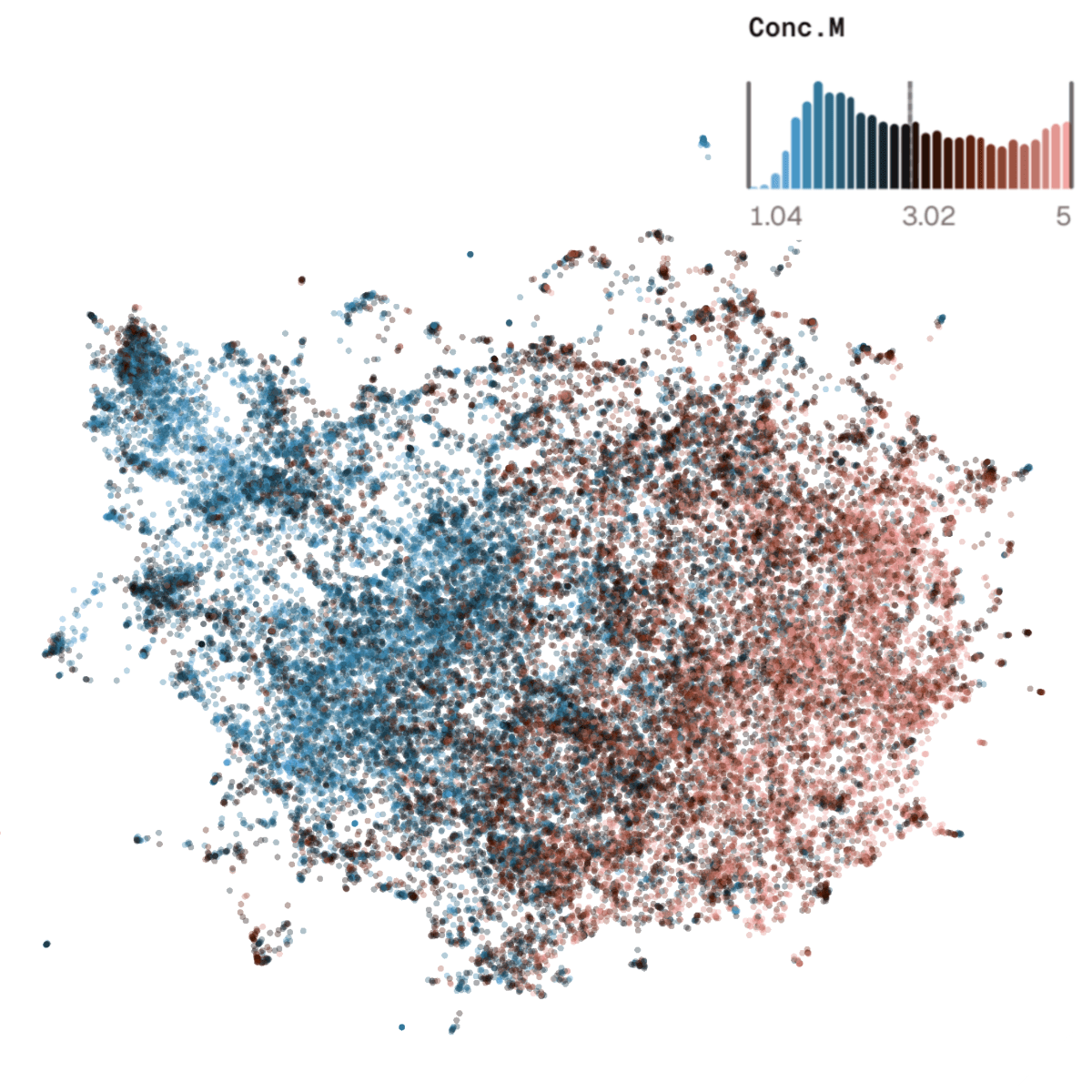
The full protocol, per-dimension results, and model comparison are in Glasgow Probing.
Refusal is a single vector away
Replicating Arditi et al. (2024) on Gemma-3-4b-it with the steering backend: a refusal direction extracted by difference-in-means and injected with ActAdd at a single layer suppresses refusal — attack success rises from 0.11 to 0.83 on JailbreakBench and from 0.21 to 0.86 on HarmBench-test (judged by Llama-Guard-4-12B) — or induces refusal on 100/100 entirely benign prompts.
The released code contains the extraction and evaluation pipeline only; no harmful completions or refusal vectors are distributed.